Catamarans for sale in France.
Sailing and power catamarans listed by vetted brokers — Fountaine Pajot, Lagoon, Bali, Catana, Nautitech and more. Across La Rochelle, Cannes, Hyeres, Marseille and the Cote d'Azur. Every listing verified, every broker vetted.
Why France matters for catamaran buyers.
France occupies a unique position in the global catamaran market: it's the home of Fountaine Pajot (La Rochelle), Catana and Bali (Canet en Roussillon), Outremer (La Grande Motte), and the historic centre of cruising-catamaran design. Roughly 40 percent of the world's production cruising catamarans are built within 200 kilometres of La Rochelle. The downstream effect is a deep, mature secondary market with strong private-owner inventory and lower charter-fleet exposure than Spain or Greece.
For buyers, France splits geographically into two markets. The Atlantic coast — La Rochelle, Les Sables d'Olonne, Lorient — is where new builds emerge and where ocean-cruising catamarans are typically listed. Pricing tends to be slightly below Mediterranean equivalents because of weather-driven seasonality. The Mediterranean coast — Cannes, Hyeres, La Grande Motte, Marseille — concentrates on premium owner boats and Cote d'Azur charter inventory. Pricing here matches Spanish levels but inventory is often privately maintained to higher standards.
Crucially, French inventory tends to be less charter-worn than Spanish equivalents. The French private-ownership culture, the prevalence of family-owned multi-decade catamarans, and the smaller scale of the Mediterranean French charter fleet all contribute. For buyers prioritising condition over selection, France is often the better value despite slightly higher headline prices.
Catamaran prices in France — 2026 ranges by length.
Indicative 2026 ranges for used cruising catamarans in the French market. Owner-version (3-cabin) prices; charter-version (4-cabin) typically trades 10 to 20 percent below. Power catamarans add a 15 to 25 percent premium. French inventory typically prices 5 to 10 percent above Spanish equivalents.
On top of the purchase price, budget transaction costs of TVA (if applicable), survey fees of 0.3 to 0.8 percent of value, and registration fees. See our complete catamaran prices guide for the full picture.
Catamarans for sale in France right now.
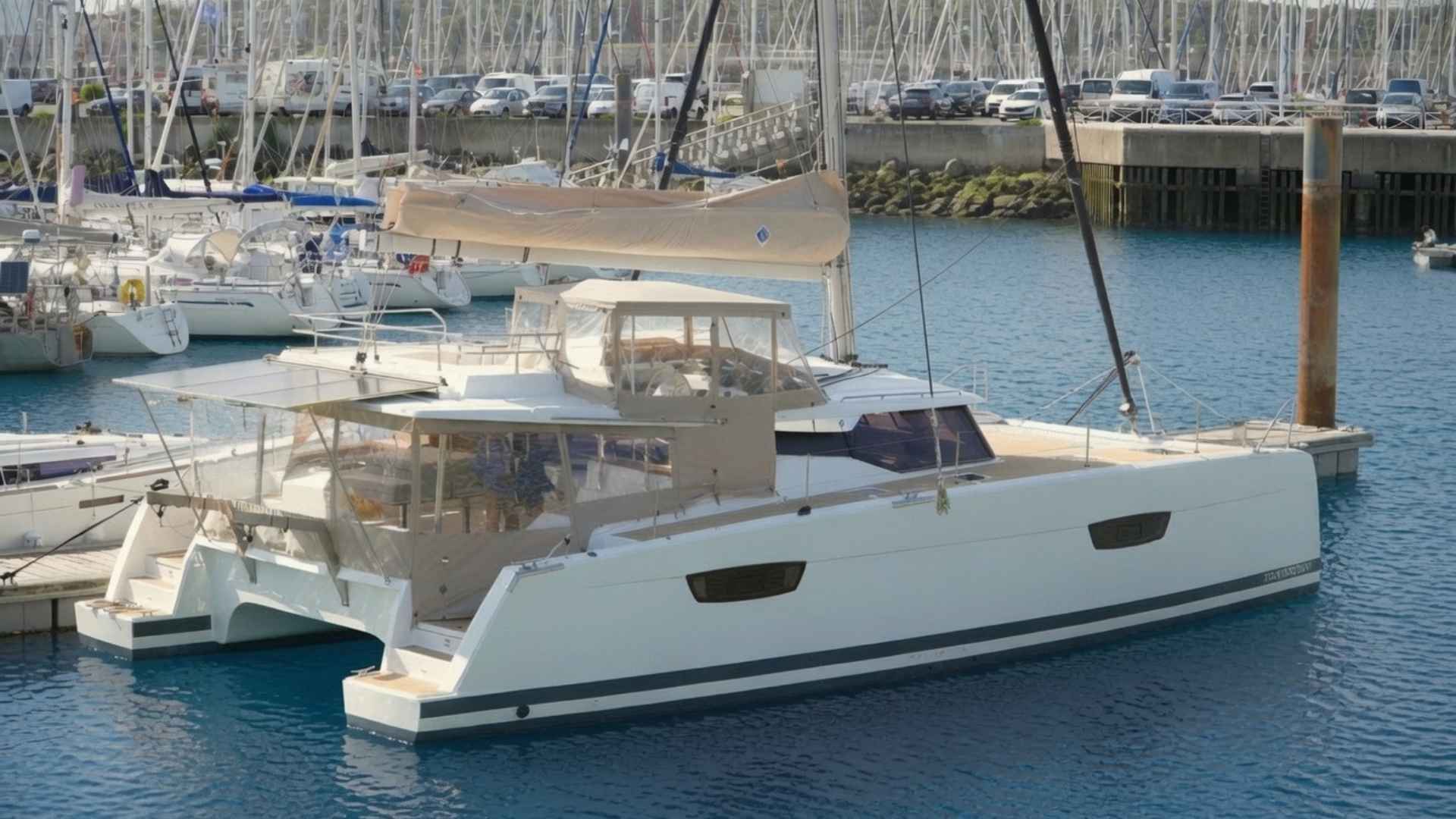
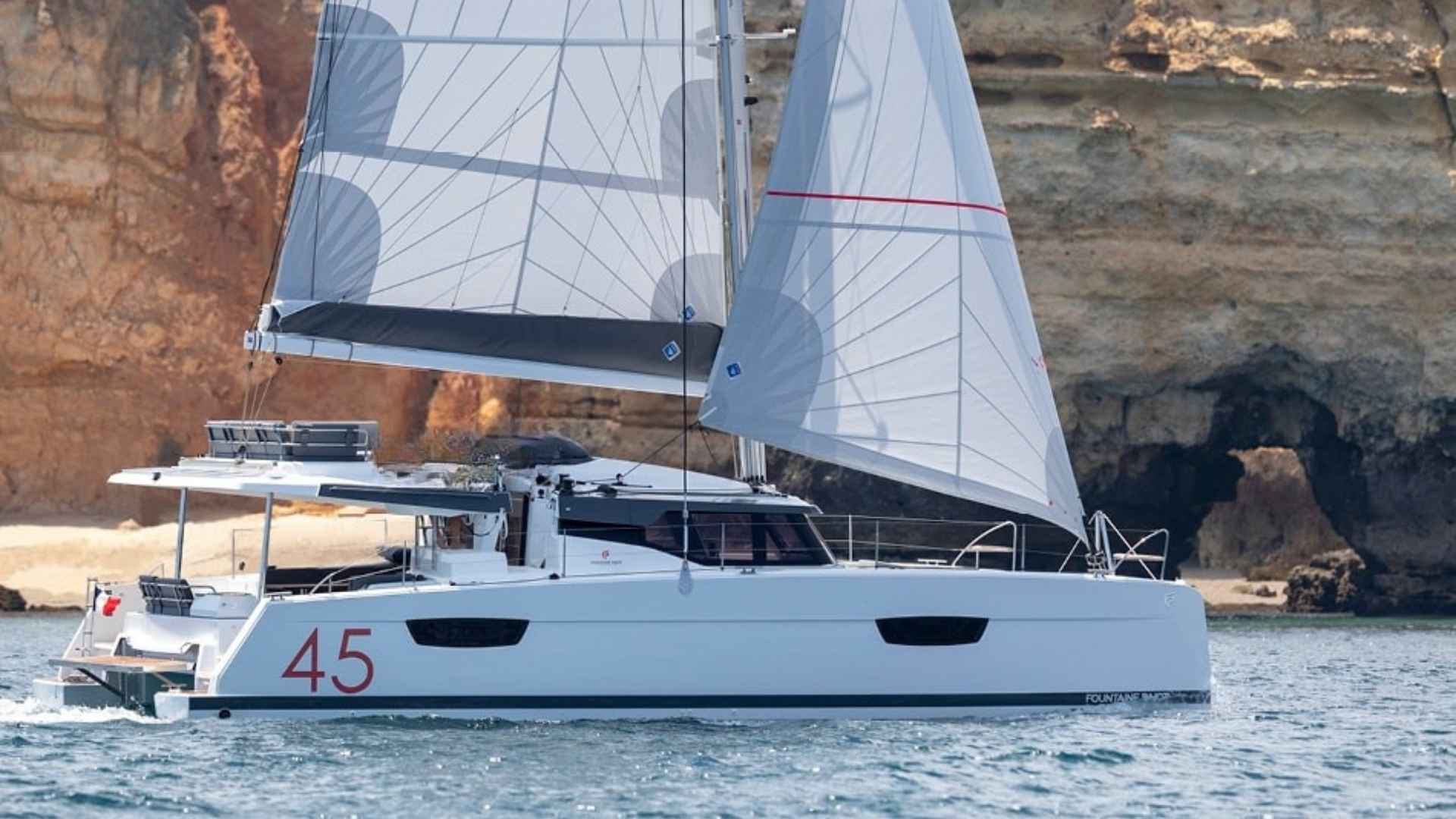
2 verified catamarans currently listed in France by vetted brokerages. Showing the 2 most recent — see all on the marketplace.
Where to view catamarans for sale across France.
French catamaran inventory clusters around two coastlines. The Atlantic side centres on La Rochelle (the Fountaine Pajot heartland), Les Sables d'Olonne, and Lorient — best for new builds, ocean cruisers, and lower-priced inventory. The Mediterranean side runs from La Grande Motte and Marseille east through Hyeres, Saint-Tropez, and Cannes — premium pricing, top condition, and the easiest viewing logistics for buyers flying into Nice or Marseille.
What to look for when buying a catamaran in France.
Private vs charter history
French inventory skews more privately owned than Spanish, but charter boats still appear — particularly on the Mediterranean coast. Ask directly: was this boat ever in charter? A 4-cabin layout signals charter origin even when not disclosed. Private-owner French inventory often justifies a 10 to 15 percent premium.
TVA documentation
Demand a TVA-paid invoice from the original sale, or equivalent EU VAT-paid certificate. Without it, you inherit a 20 percent contingent liability against the boat's value. This is the single most important document in any French catamaran purchase. A French maritime lawyer can verify status if paperwork is unclear.
Flag choice (Pavillon vs RIF vs alternative)
Most private buyers keep the standard French flag. Charter operators often prefer RIF for tax structure. Non-EU buyers commonly switch to Belgian, Maltese, or British flag. Each has different TVA, registration, and operational implications. Decide flag strategy before signing — switching later costs 4 to 8 weeks and €2k to €6k.
Survey out of the water
Catamarans must be surveyed on the hard. Saildrives, rudder bearings, hull integrity at the bridge deck, and any history of grounding all need direct inspection. Budget €1,800 to €3,500 for a full catamaran survey in France, plus haul-out fees of €500 to €1,500. La Rochelle and Cannes have the most experienced catamaran surveyors.
Berth on both coasts
Catamaran berths on the Cote d'Azur are scarce and expensive — often €15k to €40k per year for a 45-footer. Atlantic coast berths are more available and cheaper but require commitment to that cruising ground. Confirm onward berth before closing; many buyers underestimate this and end up storing on the hard for the first season.
Use a buyer's broker
In France, buyer's brokers are typically paid via co-brokerage from the listing broker's commission, so they cost the buyer nothing extra. Their job is to represent your interests, shortlist sensibly, negotiate, and coordinate the survey and closing. For buyers based outside France, this is essential — French market knowledge and language are non-trivial advantages.
More catamaran resources.
Catamarans for sale in France — frequently asked questions.
How much does a catamaran cost in France?
Used cruising catamarans in France typically range from €200k for an older 38 to 42-foot model up to €850k for a recent 50-foot Fountaine Pajot or Lagoon, and €1.3M and above for new or near-new 55 to 65-foot catamarans. French inventory tends to price 5 to 10 percent above Spanish equivalents because of higher private-owner ratios and lower charter wear.
Where in France are most catamarans sold?
La Rochelle on the Atlantic coast is France's catamaran capital — both as the home of Fountaine Pajot production and as a deep secondary market. The Mediterranean coast clusters around Cannes, Hyeres, Marseille, and La Grande Motte. Brittany (Lorient, La Trinite) and the Bay of Biscay (Les Sables d'Olonne) also host meaningful inventory, particularly for performance-oriented Catana and Outremer cruisers.
What VAT considerations apply when buying a catamaran in France?
France applies TVA at 20 percent on new catamarans and on commercial sales. Used catamarans sold privately between individuals are not subject to TVA again provided the boat carries a valid TVA-paid certificate from a previous EU sale. Always demand a TVA-paid invoice or certificate before signing — a missing TVA history creates a 20 percent contingent liability. Non-resident buyers should structure with a French maritime lawyer to assess flag and TVA implications.
Is the RIF flag worth considering for my catamaran?
The Registre International Francais (RIF) is France's international shipping registry, used for commercial and charter operations. For private-use catamarans, the standard French flag (Pavillon francais) is normally simpler and cheaper. RIF becomes relevant if the catamaran will be commercially chartered, where it offers favourable crew tax treatment and EU flag-state recognition. A French maritime lawyer should advise on flag choice as part of the purchase structure.
Can a non-resident buy a catamaran in France?
Yes. Non-residents can buy catamarans located in France without restriction. The French flag is open to EU residents and certain non-EU buyers under specific conditions; alternative flags like Belgian, Maltese, British, or Polish are common for non-EU buyers. The transaction itself is straightforward but TVA status, flag choice, and potential French wealth-tax implications for residents-of-record should all be reviewed by a French maritime lawyer before closing.
How long does buying a catamaran in France take?
Typically 6 to 10 weeks from accepted offer to closing, similar to other EU jurisdictions. The timeline includes survey and sea trial (1 to 2 weeks), legal due diligence and contract drafting (2 to 3 weeks), payment and registration transfer (2 to 4 weeks), and any flag change paperwork (adds 2 to 6 weeks if applicable). French notarial requirements are minimal compared to property transactions.
Ready to find your catamaran in France?
Browse the live inventory above, or talk directly to a vetted broker. No middlemen, no lead-generation pay-walls. The brokers behind every listing are the people you'll actually deal with.