Astrea 42 for sale.
Fountaine Pajot's compact 42-foot family cruiser. Borrows design DNA from the Saona 47 in a smaller package. Available with diesel or ODSea+ hybrid drivetrain.
The Astrea 42 — compact family cruiser.
The Astrea 42 entered production in 2018 as Fountaine Pajot's compact family cruiser, sitting between the Lucia 40 (entry level) and the Elba 45 (mid-range family). Berret-Racoupeau designed the Astrea by adapting the chined hull design from the Saona 47 to a smaller package, with FP's signature elevated single helm refined for easier sail handling.
The Astrea 42 has been one of FP's strongest sellers since launch, with production estimated at 200+ hulls through 2025. The boat is positioned to compete directly with the Lagoon 42 in the 13-metre family-cruiser segment, and on the resale market the two are frequently cross-shopped. The Astrea generally wins on sailing performance (chined hull design, lighter displacement); the Lagoon 42 generally wins on interior volume.
From 2023, FP added the ODSea+ hybrid drivetrain as an option on the Astrea 42 — alongside the Elba 45 and Aura 51, it's one of three FP models in this configuration. The hybrid version uses electric motors with a small diesel generator and extensive solar. ODSea+ Astreas command a meaningful premium and are well-suited to Mediterranean island-hopping where short-range zero-emission cruising matters.
Astrea 42 specs and dimensions.
Dimensions
- Length overall (LOA)
- 41'10" / 12.75 m
- Length waterline (LWL)
- 41'1" / 12.52 m
- Beam
- 23'7" / 7.20 m
- Draft
- 4'2" / 1.27 m
- Air draft (mast top)
- 67'7" / 20.60 m
- Light displacement
- 26,455 lb / 12,000 kg
Sails & rig
- Mainsail
- 624 sq ft / 58 m²
- Genoa
- 420 sq ft / 39 m²
- Total sail area
- 1,044 sq ft / 97 m²
- Optional code 0
- 807 sq ft / 75 m²
- Designer
- Berret-Racoupeau
Engines
- Standard engines
- 2 × Volvo D2-50 (50 hp)
- Optional upgrade
- ODSea+ hybrid electric drivetrain
- Saildrives
- Volvo MS25L
- Cruising speed
- 7 to 8 knots under power
- Max speed (engines)
- ~9 knots
Tankage & capacity
- Fuel
- 127 US gal / 480 L
- Fresh water
- 159 US gal / 600 L
- Owner version berths
- 6 (3 cabins + saloon)
- Charter version berths
- 8 to 10 (4 cabins + saloon)
- Interior design
- Pierangelo Andreani
Specifications are manufacturer figures for a base specification Astrea 42. Individual boats vary based on year, equipment, and owner modifications. Always verify against the specific boat's documentation during survey.
Owner version vs charter version — which Astrea 42?
The Astrea 42 is offered in multiple layouts. Choosing between them is the most important decision in a Astrea 42 purchase, and meaningfully affects price, resale, and how the boat actually lives.
For couples and small families
Starboard hull dedicated to a single owner suite with island queen berth, ensuite head with separate shower, and dedicated workspace. Port hull contains two guest cabins with shared head. Best for couples cruising with occasional guests and small families. Trades at a 12–18% premium to charter version.
For charter operations
Both hulls split into two cabins each with four heads. Sleeps up to 10 guests plus crew. Designed for charter operations — the dominant layout in original sales and on the resale market. Lower per-cabin price; suits buyers who want maximum capacity or plan to operate short-term charters.
Wider context on layout choice and resale implications: our charter version vs owner version guide.
Astrea 42 prices used and new in 2026.
Indicative 2026 ranges for the Astrea 42 across condition, year, and layout. Country of sale also affects pricing — Italian and French inventory typically lists 5 to 15 percent above Spanish or Greek equivalents.
For deeper context on Fountaine Pajot pricing, condition adjustments, and country-of-sale variation, see our complete catamaran prices guide.
Astrea 42s for sale right now.
3 verified Astrea 42s currently listed across the Mediterranean. Showing the 3 most recent.
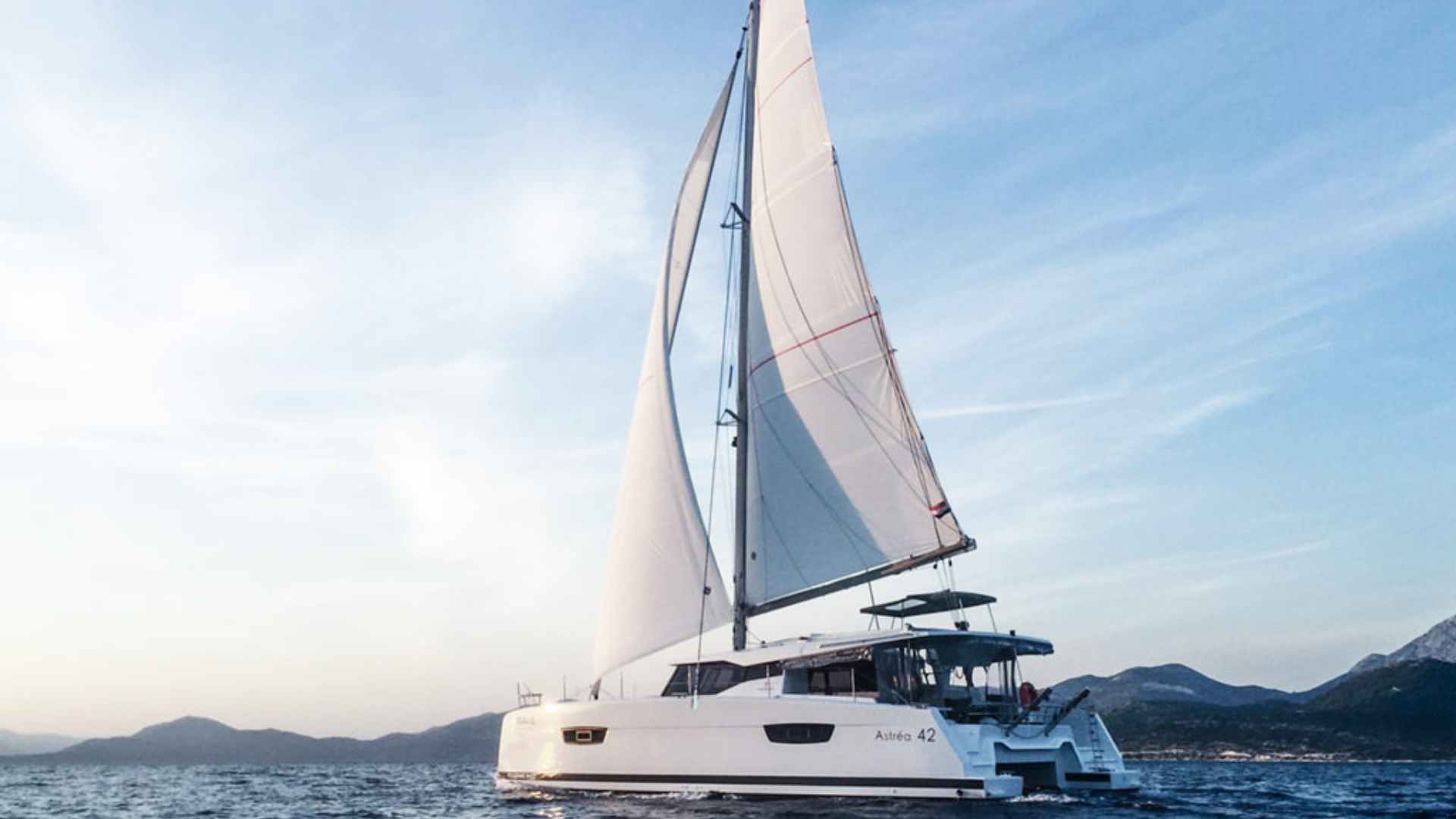
Fountaine Pajor Astrea 42 2020 For Sale
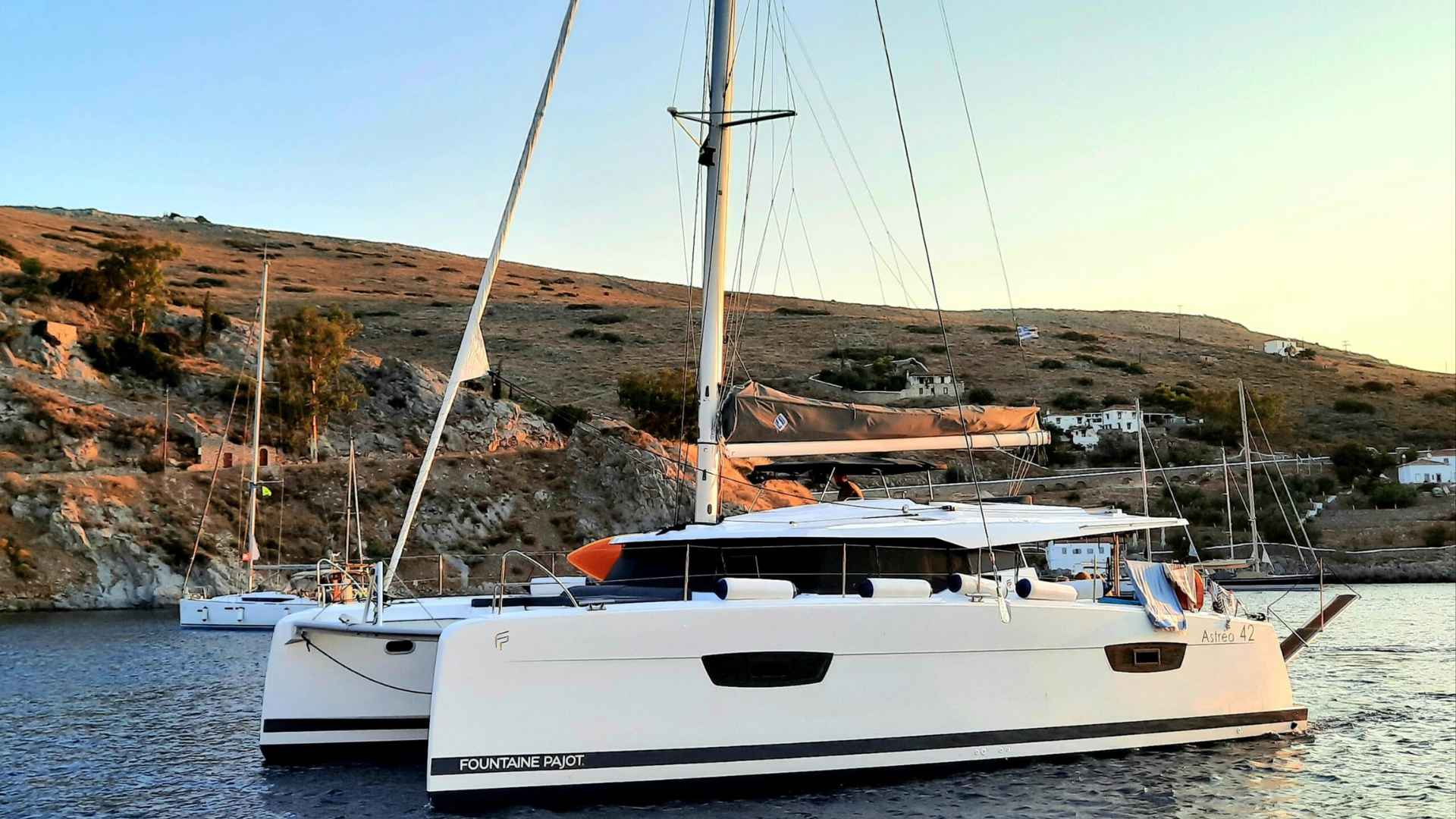
Fountaine Pajot Astrea 42 for sale 2020 (Athens)
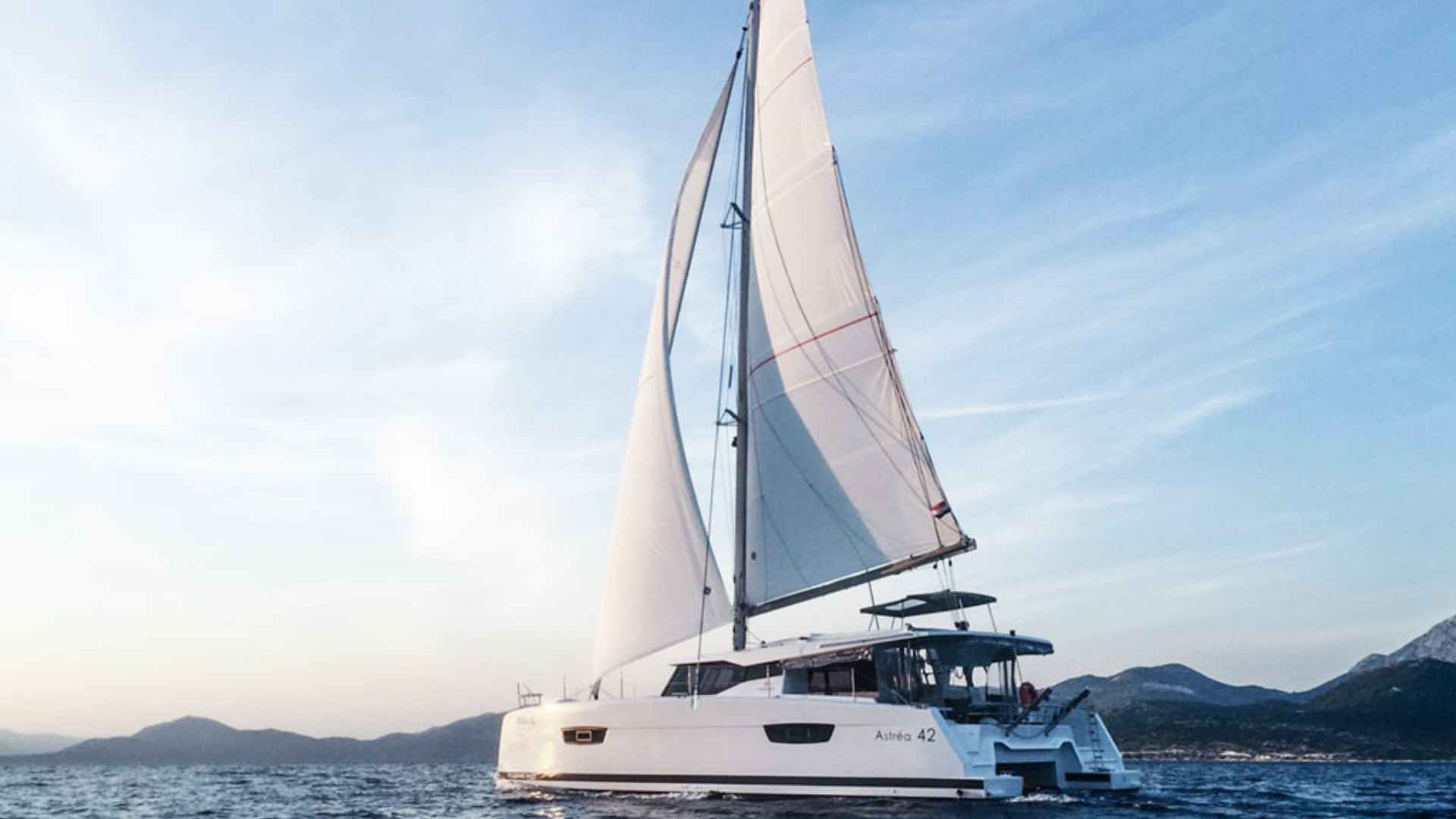
Fountaine Pajot Astrea 42 for sale 2020 (Ionian)
What to inspect on a used Astrea 42.
Volvo saildrive condition
MS25L saildrives need diaphragm and seal replacement at 5–7 years. 2018–2019 Astreas should be on second service interval; verify gear oil and saltwater intrusion.
Chined hull integrity
The Astrea 42 inherits the Saona 47's chined hull design. Inspect the chine itself and the bridgedeck-to-hull joint for any starring or stress cracks. Any concerns deserve professional structural assessment.
Engine hours by use case
Charter Astrea 42s typically show 3,500–5,500 hours by year 5; owner-version typically 800–1,800 hours. Volvo D2-50 service records should be complete.
ODSea+ hybrid systems (if applicable)
From 2023, some Astrea 42s are ODSea+ hybrid. This is a complex hybrid drivetrain — verify lithium battery state-of-health, electric motor condition, software update status. Demand FP-authorised technician documentation.
Fly-lounge UV degradation
The compact fly-lounge cushions and bimini see heavy UV exposure. Replacement cushion sets are €3,000–€6,000. Inspect for fading, mildew, and seam integrity.
Tankage and watermaker upgrades
Standard 600L fresh water and 480L fuel is workable but most cruising owners add a watermaker or auxiliary tankage. Verify upgrade quality and documentation. Factory-style watermaker installation is worth €7,000–€13,000 in resale.
Models often compared with the Astrea 42.
Astrea 42 — frequently asked questions.
How much does an Astrea 42 cost?
Used Astrea 42 prices typically range from €330k for a 2018–2019 charter-version with high engine hours, up to €720k for a 2023–2024 ODSea+ hybrid Maestro owner-version. New builds start at approximately €570k for base specification, rising to €820k and above for fully-equipped Maestro configurations.
Astrea 42 vs Lagoon 42 — which is better?
Direct competitors. Astrea 42 emphasises sailing performance via the chined hull design (lighter displacement, more responsive); Lagoon 42 emphasises interior volume and a more conservative cruising package. Lagoon 42 has the deeper parts and service network; Astrea 42 has the sailing dynamics edge. Used pricing is broadly comparable. Charter buyers tend to prefer the Lagoon 42; owner-cruisers often prefer the Astrea 42.
What is the ODSea+ Astrea 42?
ODSea+ is Fountaine Pajot's hybrid electric drivetrain, available on the Astrea 42 from 2023. It uses electric motors with lithium battery banks, a small diesel generator for charging, and extensive coachroof solar arrays. Designed for low-emission cruising in protected anchorages and short coastal hops. ODSea+ Astreas command a meaningful premium on the used market.
How many cabins does the Astrea 42 have?
The Astrea 42 is offered in two layouts: Maestro 3-cabin (owner suite in starboard hull) and Quatuor 4-cabin (both hulls split symmetrically — charter-oriented).
Is the Astrea 42 good for couples?
Yes — the Maestro 3-cabin Astrea 42 is one of FP's most popular couple-cruisers in production. The owner suite is well-proportioned, the chined hulls give meaningful sailing performance, and the 42-foot length is short-handed friendly. Many owners specifically chose the Astrea over the Lagoon 42 for the sailing characteristics.
Can the Astrea 42 cross the Atlantic?
Yes — Astrea 42s are regularly used for Atlantic crossings. The chined hull design works well in offshore conditions, and standard 480L fuel / 600L water is workable for ARC-style routes (most owners upgrade tankage further). ODSea+ hybrid versions are not well-suited to long passages where range under power matters.
Ready to find your Astrea 42?
Browse the live inventory above, or talk directly to a vetted broker. No middlemen, no lead-generation pay-walls.